One Cake, Six Countries: A Valentine’s Day Creation
Gil Asakawa • February 1, 2026

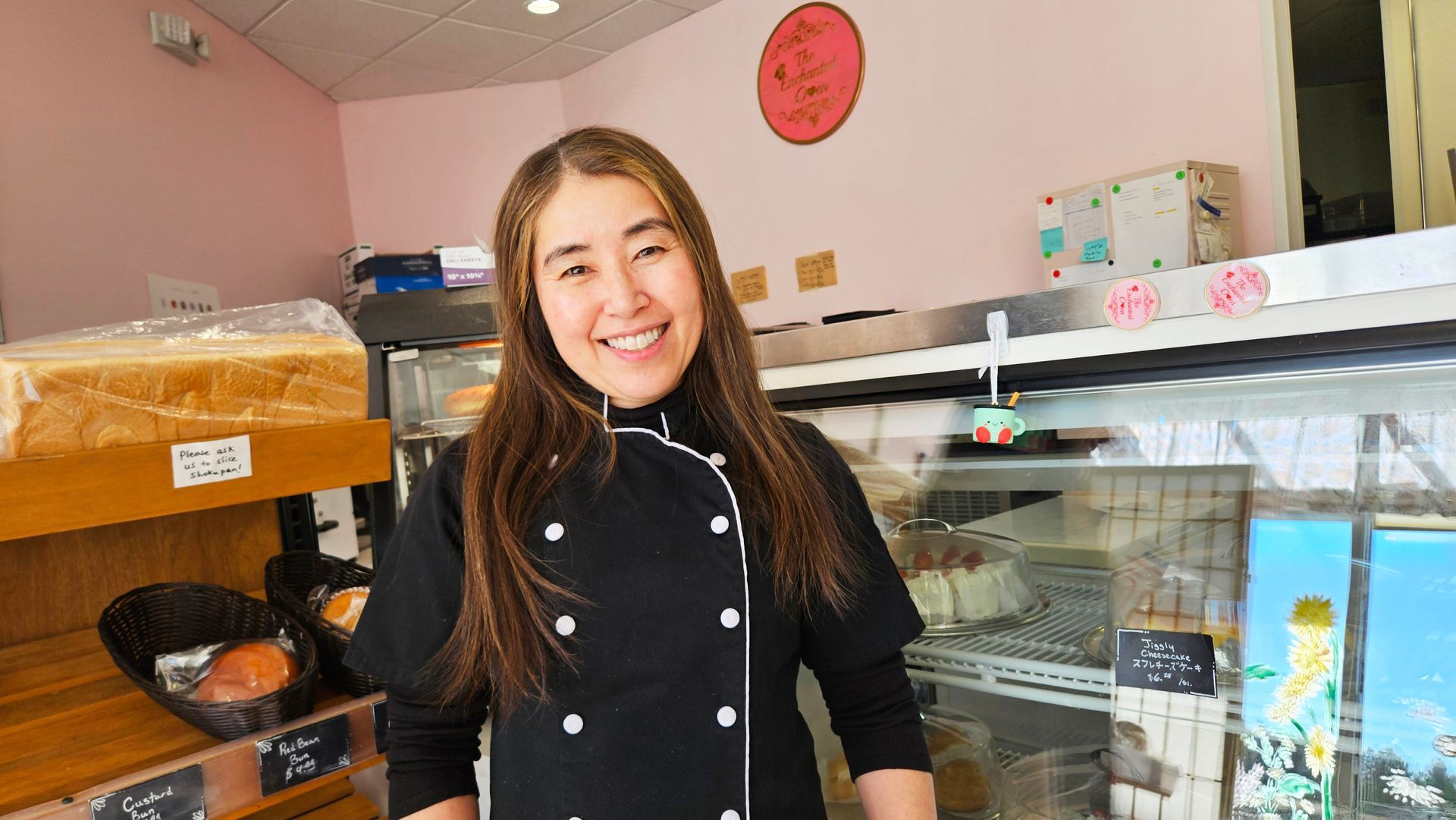
With a name like The Enchanted Oven, you know this bakery must bake fairy-tale love into its creations. For Valentine’s Day, you can expect heart-shaped cookies and cakes from owner and baker Maki Stephens. 


At her Broomfield bakery near Flatirons Mall—where she proudly honors her Japanese culture—she is also planning a special cake for the lovers’ celebration. She hopes it will inspire love around the world – dare we say “world peace?”


Her Valentine’s Day cake, which needs to be preordered, will be a showcase of cakes that represent six different countries.


“I’ve made many cakes, not just Japanese cakes,” she says, noting that she gets the wildest requests and is “too stupid to say no.”


Some of those cakes were completely new to her, requiring research, comparing recipes, and experimenting before she went with her gut. Along the way, she discovered cakes from around the world, which inspired her Valentine’s Day vision. 


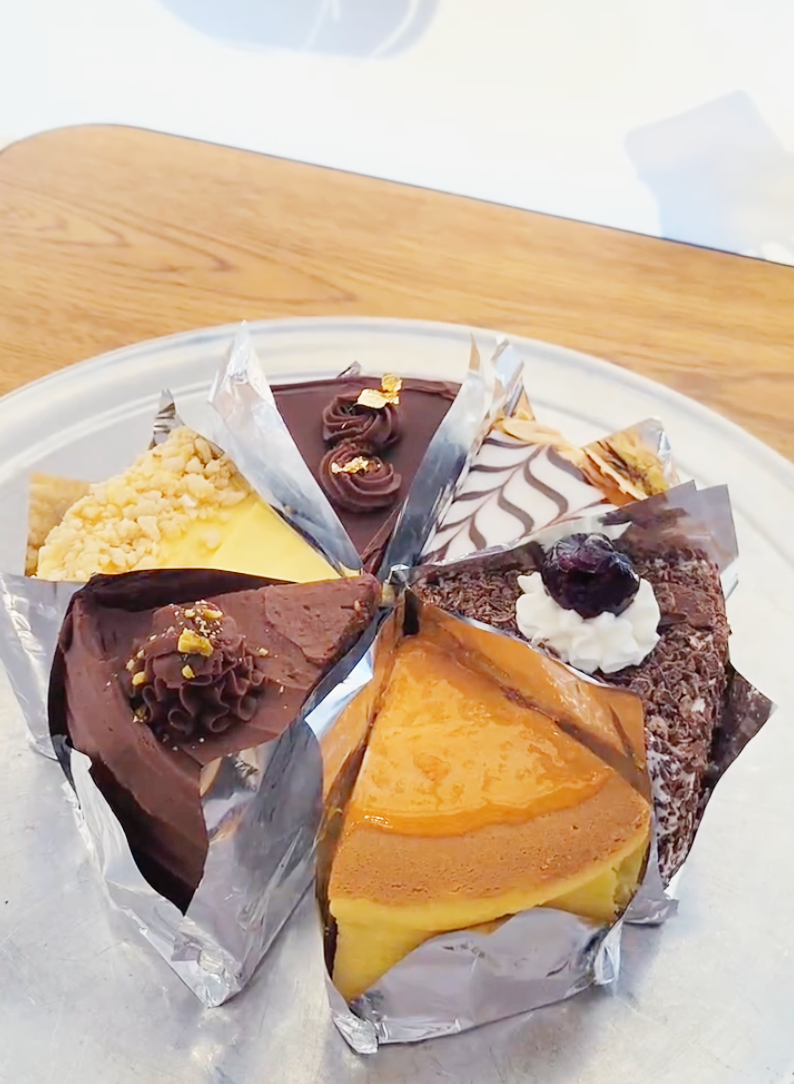
She’ll bake six cakes and cut them into six slices, then reassemble them into one global cake. The slices include Sans Rival (“without rival” in French), a cake from the Philippines that was one of the first unusual requests she baked, which is made with five layers of cashew meringue, each separated by rich French buttercream. 


Other slices include Esterházy Torta from Hungary, Opera Cake from France, Dubai-style Chocolate from the UAE, Black Forest from Germany, and representing Stephens’ Japanese roots—a Jiggly Cheesecake with apricot glaze.

Smiling woman in black chef coat stands in bakery.

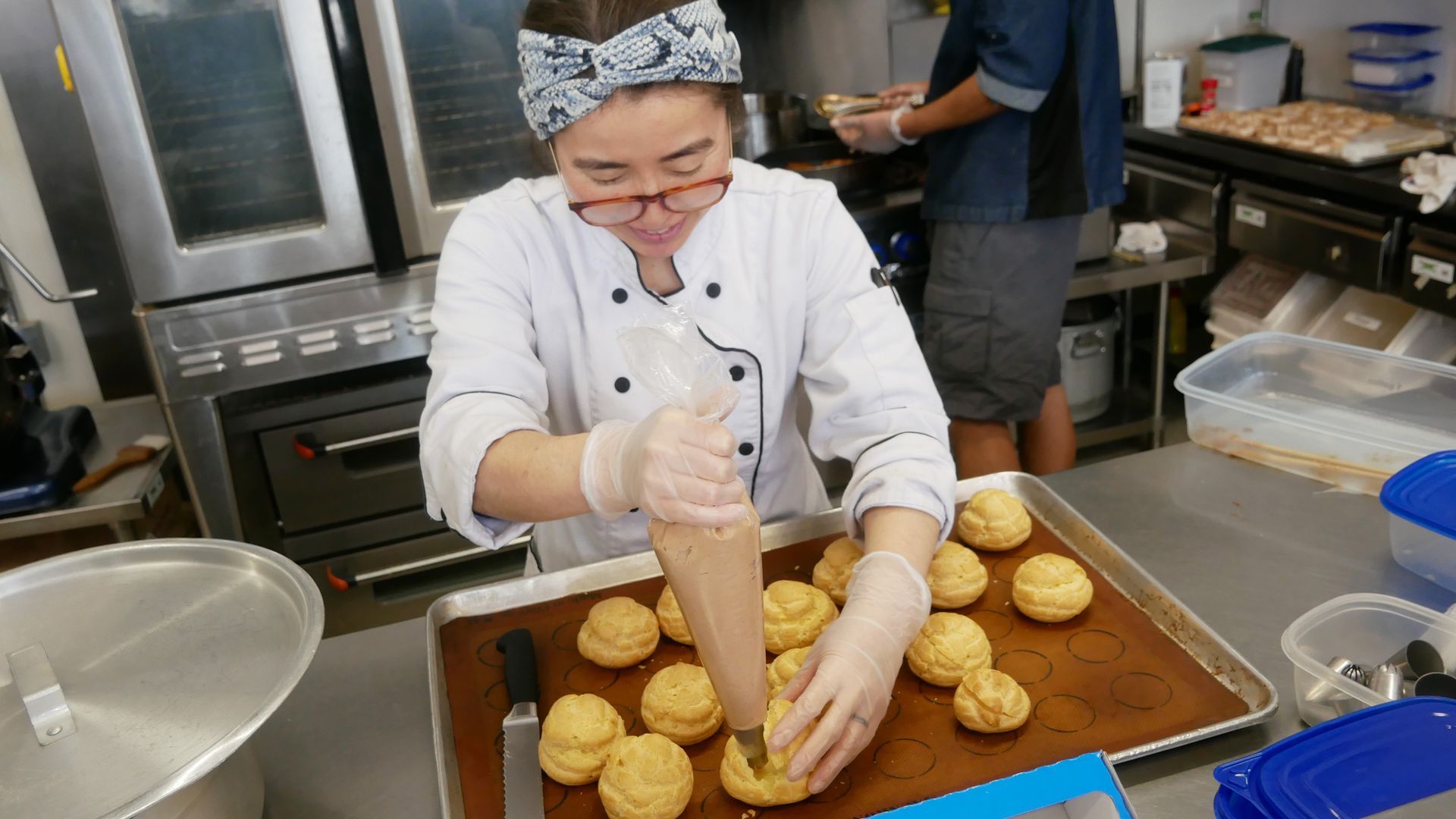
Stephens started making pastries and cakes because her daughter Elissa fell in love with cream pan, custard-filled pastries popular in Japan. It took trial and error before she succeeded, but once she got it down for “Eh-chan,” Elissa’s nickname, Stephens found herself baking for family and friends, and friends of friends. With her husband Rod’s support, she left her jobs translating English to Japanese and working as a gymnastics dance choreographer to open the bakery—named after her daughter (“Eh-chan’s bakery,” get it?). In fact, The Enchanted Oven opened on Valentine’s Day in 2019.


She makes familiar baked goods including cakes, cookies, pastries and buns, but also serves up Japanese specialties, including Shokupan, or fluffy sweet Japanese milk bread that’s so essential to the magic in Japanese sandos, or sandwiches. And yes, she makes the popular egg salad sandwiches, tamago sandos, that 7-Eleven just started selling in Colorado (hers are better).


The Enchanted Oven also sells the Cream Pans that inspired Stephens’ baking, Hawaiian Butter Mochi cake, and Nikkuman, or hot pork buns. Beyond baked goods, their weekly emails promote a Bento Box special dish that customers can preorder and pick up. After Thanksgiving, Stephens took orders for Osechi Ryori, a boxed set of traditional Japanese dishes for Oshougatsu, or New Year’s, with symbolic foods for good luck, good health, prosperity and long life. 


The Enchanted Oven reflects a commitment to Japanese culture, quality of food, and thoughtful service—values that are deeply ingrained in Maki Stephens’ heart. It’s a treasure of a shop, and her long-term goals for the bakery involve adding a separate area where she can teach small cooking classes. Sign us up!

Assortment of cake slices on a silver platter, each wrapped in foil. Flavors vary, with chocolate and fruit.

Discover More Features

By Ashtonn Means April 1, 2026
Rocky Mountain Public Media , the home of Rocky Mountain PBS, KUVO Jazz, and TheDrop303 has a partnership with Colorado Ethnic Media Exchange to launch this monthly essay series, as part of our vision to co-create a Colorado where everyone feels seen and heard. These stories are sourced from community members across the state—told in their own words and selected from our 64-county community ambassador program. They are not editorial products of our journalism team, but are first-person reflections on life in Colorado - building bridges through empathy. Learn more about all of our brands and content at www.rmpbs.org/about .
By Gil Asakawa April 1, 2026
When people discover Boxtastic at Denver International Airport, they’re often drawn in by the bright displays, colorful characters, and the excitement of opening a “blind box.” Behind that experience is Michael Ye, quietly building and shaping the vision of Boxtastic alongside his wife, Mimi Luong Ye. While Mimi is often the face of the brand—connecting with the community, sharing stories, and bringing energy to events—Michael is the one carefully crafting what Boxtastic is becoming. In 2024, he noticed a growing trend while running their family gift shop, Truong An Gifts, in Denver. Labubu dolls made by Pop Mart, a Beijing-based toy company, had become an explosive fad. Pop Mart sells the line of various Labubus in a “collect them all” ethos of blind boxes, in which the exact item inside is a surprise until it’s open. Then consumers keep buying them to collect the other ones. Labubus became Pop Mart’s biggest worldwide hit. After Truong An’s Labubu popularity and long lines waiting outside their gift shop door caught the attention of Denver International Airport, the Ye’s came up with Boxtastic, which was more open-ended and not tied to just the Labubu fad. Like a spinoff for a hit television show, Boxtastic, is inspired by the blind boxes that generate repeat purchases.  “It’s kind of become the thing that I love,” Ye says of the Truong An-inspired world of retail. “And Boxtastic is just a version of that. It’s a spin-off.”
By Dr. Esther Park April 1, 2026
For Dr. Esther Park, the path to becoming a psychologist wasn’t linear—it was deeply personal. Like many children of immigrants, she grew up with a clear expectation: become a doctor or a lawyer. “For a while, I believed I would be a pediatrician,” she recalls. “But on the first day of organic chemistry in college, I quickly realized medical school wasn’t for me.” What followed was a quiet but powerful shift. Park gravitated toward psychology, initially without a clear end goal. “Looking back, I can see that I was drawn to it for deeply personal reasons,” she says. “There was something I wanted to understand about myself, my upbringing, and the dynamics that shaped me.” That curiosity eventually led her to earn a doctorate in clinical psychology and continue her training at the Denver Institute for Psychoanalysis. Dr. Park describes her identity as a 1.5 generation Korean American as central to her work. “I understand, intimately, what it feels like to belong and to feel ‘other’—sometimes in the very same moment,” she explains. Holding both Western and Korean values has created what she calls a “dual identity,” shaped by autonomy and self-definition on one hand, and sacrifice, duty, and collective identity on the other. This duality brings both gratitude and grief. “I carry gratitude for the immense sacrifices my parents made… But I also carry a lot of grief. The grief of recognizing that my freedom is, in many ways, built on their limitation.” These layered emotions inform how she approaches her patients—with nuance, curiosity, and compassion. “I don’t see mental health symptoms in isolation. I see them within cultural systems, generational trauma, and the psychological weight of belonging.” Dr. Park emphasizes that many mental health challenges—like anxiety, depression, and perfectionism—are often rooted in intergenerational experiences. “We do not start from scratch,”she says. “We are shaped not only by our own experiences, but by the emotional histories of the generations before us.” In immigrant families, survival stories often translate into internal pressures: achieve, don’t fail, make it worth it. “These messages are often rooted in love,” she adds, “and yet, they can become internal pressures that shape identity in profound ways.” Starting her own private practice was another intentional step in reclaiming autonomy. “I wanted the freedom to build a practice that reflected my values,” Park says. “My parents immigrated to this country without the luxury of time…Because of that, I’ve come to see time as one of the most valuable forms of wealth.” Her work, grounded in psychodynamic and psychoanalytic therapy, goes beyond symptom relief. It invites deeper self-exploration and lasting change. “Many of the individuals I work with are interested in understanding themselves at a deeper level—not only to improve their own lives, but to change patterns that may have existed across generations.” It gives Dr. Park hope that “more individuals are beginning to ask deeper questions about themselves—not just what they feel, but why.” She hopes more people can see self-understanding not as a weakness, but as courage.